


Agilent laboratory equipment wordmark

Technical documentation for laboratory, infection-control, and connected-care procurement

Agilent analytical laboratory instrument workflow

Laboratory systems · documented evaluation · lifecycle planning

Evidence-led Agilent lab equipment

Compare analytical workflows, model-specific documentation, service scope, and integration needs before a laboratory, infection-control, or connected-care purchase moves to approval.

Procurement baseline

Define the acceptance envelope before comparing models

The figures below are example requirement bands from the industry configuration, not universal Agilent model claims. Confirm every value in the applicable data sheet, IFU, quotation, and market authorization.

Analytical performance

Analyzer throughput requirement
600–2,000 tests/hour when high-volume chemistry automation is in scope
Precision review
Coefficient of variation (CV), bias, reportable range, calibration interval, and lot-to-lot behavior
Detection capability
Limit of detection (LOD), lower limit of quantification, matrix effects, and carryover under the intended method

Integration and governance

Laboratory connectivity
HL7 v2.5.1 ORM/ORU, LIS middleware behavior, user-role controls, and audit-trail retention
Quality evidence
Design history file (DHF), device master record (DMR), risk-benefit analysis, and post-market surveillance scope where applicable
Security review
SBOM availability, patch governance, access control, encryption, and coordinated vulnerability disclosure for connected systems

Evidence path

Three review tracks keep technical claims attached to their conditions

Laboratory team reviewing method validation records

01 · Method fit

Start with sample, method, and decision threshold

A useful specification names the matrix, preparation path, expected concentration range, interference panel, precision target, and turnaround-time requirement. A headline sensitivity value without those conditions cannot establish clinical or analytical fit.
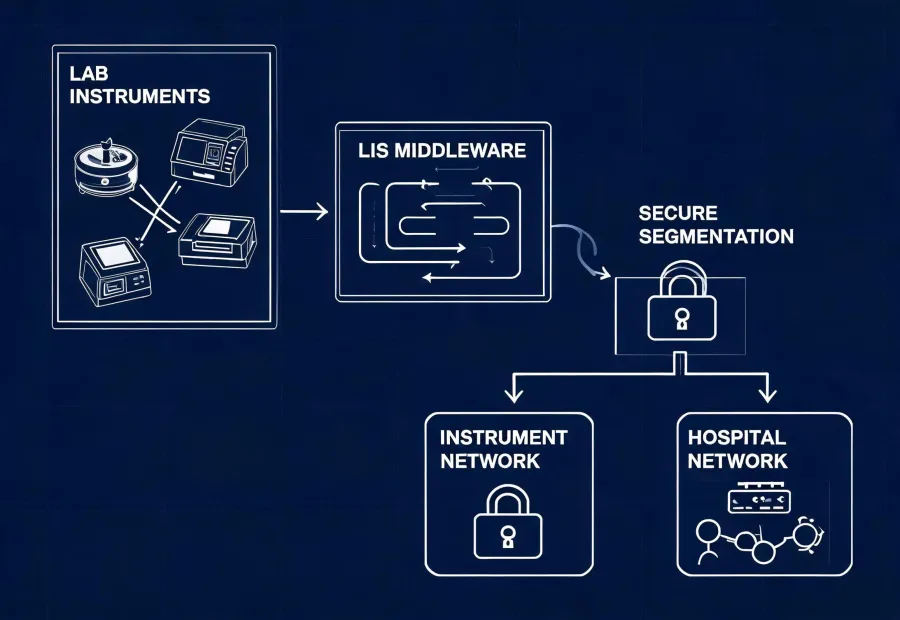

Laboratory integration architecture review

02 · Workflow fit

Trace every handoff from accessioning to verified result

Map primary-tube loading, cap piercing, rerun rules, reflex testing, calibration, QC lockout, middleware routing, and exception handling. This exposes labor and integration constraints that a throughput maximum alone will miss.

Biomedical service planning for laboratory instruments

03 · Lifecycle fit

Price the operating model, not only the instrument

Document preventive-maintenance intervals, consumable dependencies, response targets, remote-access policy, training, decommissioning, and parts availability. Service assumptions belong in the same approval record as analytical performance.

Documentation framework

Standards and regulations to verify by product and market

Listing a framework here does not claim that every model holds every clearance or certification. Procurement teams must obtain the current, model-specific evidence.

IVDR

EU IVDR 2017/746

Check intended purpose, classification, notified-body status where required, performance evaluation, and post-market performance follow-up for an in-vitro diagnostic.

13485

ISO 13485 quality management

Review the certificate scope, covered legal entity and sites, issuing certification body, issue date, expiration date, and exclusions rather than relying on a logo alone.

14971

ISO 14971 risk management

Confirm that hazards, risk controls, verification evidence, residual-risk evaluation, and production feedback connect to the specific device configuration.

62304

IEC 62304 software lifecycle

For software-enabled equipment, examine software safety classification, change control, anomaly handling, verification traceability, and release documentation.

Care and laboratory settings

Evaluation changes with the operating environment

CL

Core Laboratory

Automation, peak-hour throughput, QC governance, reagent handling, and LIS exception routing.

RL

Reference Laboratory

High-volume batching, method transfer, multi-site traceability, and standardized result reporting.

IC

Infection Control

Sterility assurance level, cycle records, lot traceability, reprocessing validation, and waste trade-offs.

CC

Connected Care

Device interoperability, cybersecurity, access control, network resilience, and clinical escalation.

Workflow perspective

What a defensible evaluation record needs to answer

Prepare a scoped request

Bring the model, method, site, and evidence list into one Agilent inquiry

A focused request helps separate catalog-level information from configuration-specific facts.

  • Product family and model or configuration under review
  • Sample type, method, throughput, and acceptance criteria
  • LIS, network, cybersecurity, and data-retention requirements
  • Required regulatory, service, training, and lifecycle documents